
The dynamic between a father and a young child is a uniquely powerful force in early childhood development. In recent years, developmental psychology has shed incredible light on the profound, long-term impact of paternal involvement during the toddler years. When fathers actively engage in the daily rhythms of play and education, they do not just offer a helpful hand; they introduce a distinct style of interaction that significantly shapes a child’s cognitive, social, and physical architecture. For busy fathers managing demanding careers, the challenge often lies not in a lack of desire to connect, but in finding practical, meaningful ways to maximize the limited time available.
By focusing on structured, high-value educational playtime, fathers can transform brief daily windows into monumental learning milestones. Utilizing intentional learning activities for dads and toddlers ensures that play goes beyond passive entertainment and becomes an active engine for growth. When a father steps into the world of a toddler with enthusiasm, a clear plan, and the right tools, ordinary moments become an arena for building problem-solving skills, physical agility, and emotional resilience. This comprehensive exploration delves deep into the science of paternal bonding, maps out high-impact developmental activities, and shows how modern educational frameworks can make interactive learning seamless for the modern, busy father.
The Unique Cognitive Impact of Paternal Play
To fully appreciate the value of structuring specific learning activities for dads and toddlers, it helps to look at how paternal interaction styles uniquely benefit a developing mind. Research consistently demonstrates that fathers often engage in play that is physically dynamic, exploratory, and highly encouraging of independent risk-taking. This distinct approach complements maternal nurturing by introducing a variety of essential cognitive and behavioral challenges.
Building Resilience Through Rough-and-Tumble Exploration
Paternal play frequently involves a greater degree of physical movement, balance challenges, and active exploration. This style of play helps toddlers develop spatial awareness, body boundary security, and physical confidence. When a dad guides a child through safe, physical challenges, the toddler learns to navigate minor risks, handle sudden changes in position, and bounce back quickly from small stumbles. This physical resilience transitions directly into emotional grit, teaching the child to face unfamiliar situations with a calm, confident mindset.
Expanding Vocabulary Through Direct, Varied Communication
Studies in linguistics show that fathers often speak to their toddlers using a different lexical range than mothers. While mothers frequently adjust their vocabulary to mirror the child’s current linguistic comfort level, fathers tend to use more direct, adult-like language and diverse terminology. When pairing this expansive communication with real-time activities, fathers act as a linguistic bridge to the outside world. They introduce technical terms, descriptive adjectives, and action-oriented verbs that rapidly expand the toddler’s internal dictionary, boosting future reading comprehension and oral expression.
Fostering Independent Problem-Solving and Autonomy
Fathers often take a step-back approach during task challenges, allowing toddlers to grapple with a puzzle or a mechanical problem a bit longer before intervening. This subtle encouragement to persevere builds frustration tolerance and critical thinking. When a toddler is given the space to figure out how a mechanical piece fits together under the supportive, watchful eye of a father, they internalize a deep sense of personal capability and intellectual independence.
Maximizing Limited Time with High-Value Play
For many fathers, the reality of a modern work schedule means that hours of open-ended playtime are not always a daily option. The beauty of early childhood education, however, is that toddlers do not require massive blocks of time; they require focused, undistracted, high-quality consistency. Twenty minutes of intentional, deeply engaged interactive learning can carry far more developmental weight than two hours of passive supervision.
The secret to maximizing these short intervals is intentional structure. By entering a play session with a clear developmental objective—whether that is practicing fine motor control, exploring spatial geometry, or building phonetic skills—fathers can strip away the guesswork. This targeted approach transforms play from a chaotic, exhausting chore into an organized, deeply rewarding ritual that both father and child look forward to every single day.
High-Impact Developmental Activities for Dads and Toddlers
Implementing high-value learning activities for dads and toddlers is highly rewarding when utilizing everyday materials and natural household environments. Here are four structured, developmentally rich activities designed to fit seamlessly into a busy paternal schedule while delivering massive educational benefits.
1. The Blueprint Building Challenge
Toddlers are fascinated by structural alignment, stacking, and gravity. Transforming a basic block-building session into an architectural project introduces foundational mathematical and physics concepts.
-
The Setup: Gather a collection of wooden blocks, cardboard boxes, or interlocking plastic bricks. Sit together on a firm, flat floor space where building can happen safely.
-
The Activity: Instead of simply letting the child stack items aimlessly, introduce a basic blueprint or structural objective. Say aloud, Let us build a sturdy garage for your yellow car that needs a wide doorway and a flat roof. Work together to test which blocks provide the most secure foundation.
-
The Learning Outcome: This activity introduces spatial reasoning, geometric categorization, and structural engineering principles. Toddlers discover that a wide base supports more weight, and they learn to sort objects by length, width, and balance properties, strengthening early mathematical thinking.
2. The Great Household Sound and Sight Safari
Turn an ordinary evening at home into an investigative expedition that sharpens sensory processing and descriptive vocabulary.
-
The Setup: Grab a simple household flashlight or a magnifying glass to create the atmosphere of a real safari exploration.
-
The Activity: Lead your toddler through different rooms of the house to discover and identify specific textures, hidden objects, or acoustic patterns. Challenge them to find three things in the kitchen that make a metallic clicking sound, or use the flashlight to illuminate different patterns hidden in the living room rug. Use highly descriptive, sophisticated words to narrate the safari, describing items as translucent, rigid, velvety, or resonant.
-
The Learning Outcome: This sensory safari refines auditory and visual discrimination skills. It trains the toddler’s brain to notice fine details in their environment, improves observational focus, and builds a robust, contextual vocabulary anchored to real physical experiences.
3. The Rhythmic Tool and Construction Lab
Toddlers love to mimic the practical, hands-on tasks they see adults perform. Creating a rhythmic construction lab using child-safe toy tools allows fathers to teach patterns, sequence, and manual dexterity.
-
The Setup: Utilize a child-safe set of plastic tools, or gather basic household containers with lids, large plastic nuts and bolts, and hollow tubes.
-
The Activity: Work together to match lids to containers, twist components into place, and hammer plastic pegs into a board. Introduce a musical, rhythmic element to the coordination. Tap out a steady, simple beat with a plastic hammer—such as tap-tap-pause—and encourage your toddler to match that precise rhythm with their own tool.
-
The Learning Outcome: The twisting, turning, and precise hitting movements strengthen fine motor coordination and wrist stability, which are critical prerequisites for writing. The rhythmic replication introduces the concept of structural patterns and auditory pacing, which are core foundational elements of mathematical logic and music appreciation.
4. Interactive Mapping and Obstacle Courses
This activity blends gross motor development with spatial awareness and basic directional language, utilizing a father’s natural inclination for active, whole-body play.
-
The Setup: Use living room couch cushions, soft blankets, and low stools to map out a safe, indoor obstacle path.
-
The Activity: Guide your toddler through the course using clear, precise spatial directions. Instruct them to crawl under the soft blanket, step carefully over the blue cushion, and walk around the low stool. To add an extra layer of literacy, draw a very basic paper map showing symbols for each obstacle and check them off together as the course is completed.
-
The Learning Outcome: Gross motor coordination, balance, and spatial planning are heavily exercised during this activity. Furthermore, connecting spoken directional words (under, over, through, around) with immediate physical actions helps the brain map spatial prepositions accurately, accelerating language comprehension.
Leveraging the Learning Time A+ Program to Simplify Paternal Play
While fathers possess an incredible capacity to drive these activities, coming up with fresh, structurally sound educational content after a grueling workday can feel mentally taxing. This is where integrating a professional, ready-to-use framework like the Learning Time A+ Program can completely transform the father-child play dynamic.
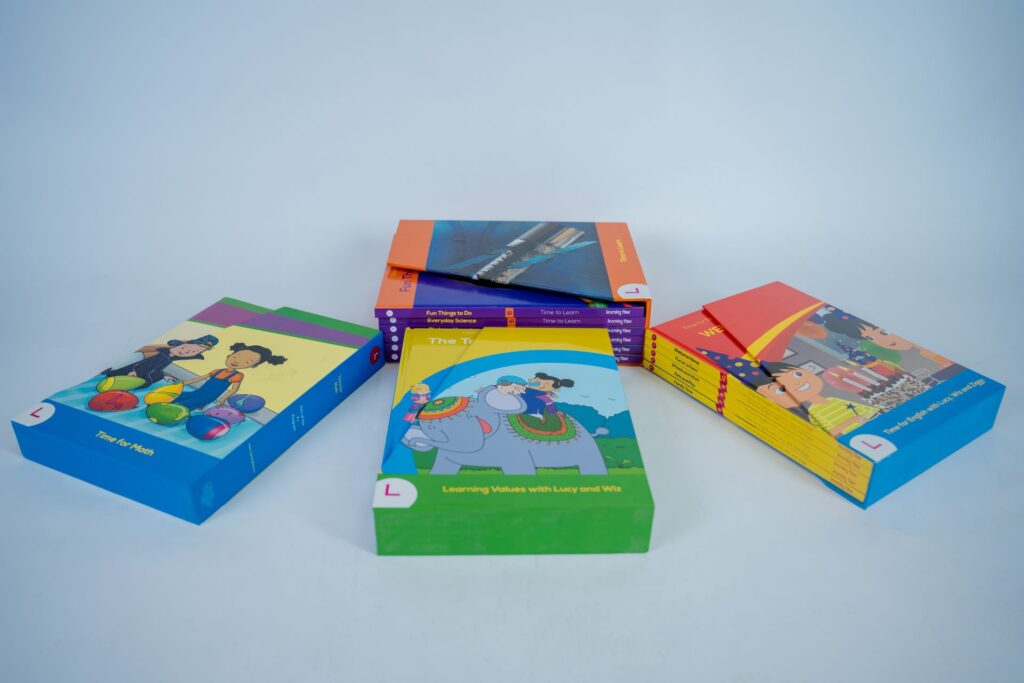
The Learning Time A+ Program provides a comprehensive, multi-sensory toolkit designed to take the guesswork out of home education. Featuring an expansive suite of interactive books, tactile activity kits, and an intelligent responsive audio pen, the program allows busy fathers to dive straight into high-value learning activities for dads and toddlers without requiring hours of advance preparation.
When a father sits down with his toddler and opens a Learning Time A+ flashcard set or storybook, the responsive audio pen serves as an entertaining, interactive co-pilot. Dad and toddler can explore detailed illustrations together, using the pointer to activate clear pronunciations, realistic nature sounds, and fun, multi-lingual vocabulary tracks. This interactive setup removes the pressure from the father to act as a formal lecturer; instead, it positions him as a supportive teammate who shares in the wonder of discovery.
The physical learning kits included in the program provide immediate, structured hands-on tasks—such as matching shapes, identifying animal families, or exploring numerical values—that align perfectly with a father’s natural preference for tangible, action-oriented play. By spending just fifteen minutes a day working through a Learning Time A+ module, a father can guarantee that his limited free time is being directed toward the exact cognitive, linguistic, and motor milestones his toddler needs to achieve, creating an efficient, stress-free, and incredibly high-impact bonding routine.
Creating an Organized and Safe Environment for Focused Bonding
To ensure that these interactive sessions remain calm, highly educational, and deeply enjoyable for both father and child, establishing a safe physical framework and clear spatial boundaries is absolutely essential.
Eliminating Digital and Visual Disruptions
Before beginning an interactive learning session, intentionally eliminate background distractions. Turn off televisions, put away smartphones, and close laptop screens. This simple act creates a sacred, focused container for connection. It signals to your toddler that they have your absolute, undivided attention, which dramatically lowers behavioral anxiety, increases their attention span, and allows them to lock into the educational task with maximum cognitive focus.
Maintaining Safety Standards During Active Play
Given that paternal play is often physical and exploratory, maintaining proactive safety standards is a top priority. Always ensure that the play area is completely clear of sharp corners, fragile household decor, or tripping hazards. If an activity involves small sorting pieces, water, or natural elements, maintain close, side-by-side supervision to prevent any choking risks, as toddlers are naturally inclined to use their sense of taste to investigate new shapes.
Curating a Fresh Rotation of Play Materials
Rather than cluttering the play space with a massive box containing dozens of scattered, unorganized toys, present a carefully curated selection of two or three high-quality items or books at the start of your session. This intentional limitation prevents sensory overstimulation, helps your toddler sustain a deep, meaningful focus on the specific problem or story at hand, and ensures that the educational value of the material is fully explored and absorbed.
Turning Clean-Up Time into a Collaborative Victory
At the conclusion of a high-energy learning session, the transition to tidying up the play area provides a fantastic, often missed opportunity to reinforce early development, responsibility, and teamwork between a father and toddler.
Gamifying the Organization Process
Instead of viewing clean-up as a frustrating end to the fun, frame it as a final, collaborative mission. Create a cheerful, rhythmic sorting game out of returning pieces to their designated boxes. You can use clear instructions that exercise cognitive categorization, such as, Can you find all the long green blocks and place them into this square bin while I gather the small red ones?
Celebrating the Power of Teamwork
Sing a fun, steady clean-up song together as you work, and celebrate the completed task with an enthusiastic high-five or a shared moment of pride over the neat space. This cooperative ending teaches toddlers that caring for their tools and environment is a satisfying, natural conclusion to creation. It builds essential life skills, reinforces sorting and organizational metrics, and provides a gentle, calming transition from active, high-energy play back into the peaceful, quiet routines of the evening.
The Lifelong Impact of Paternal Learning Foundations
The dedication a father invests in consistency executing structured learning activities for dads and toddlers yields beautiful, permanent rewards that extend far beyond early childhood. The cognitive, physical, and emotional pathways built during these brief home sessions establish a trajectory of confidence and academic security that lasts a lifetime.
Children who grow up with actively engaged fathers who participate in their early learning journeys demonstrate significantly higher levels of social competence, advanced verbal abilities, and superior mathematical problem-solving skills when they enter formal schooling. They approach unfamiliar academic challenges with a reduced fear of failure because they have spent years learning to navigate risks, test hypotheses, and bounce back from stumbles under the encouraging guidance of their fathers.
Furthermore, the deep emotional security forged during these interactive play sessions creates a permanent psychological anchor for the child. They enter the wider world knowing they are deeply valued, listened to, and supported. By making the intentional choice to enrich your busy schedule with focused, multi-sensory educational play, you are not merely filling an open half-hour in your evening; you are gifting your toddler an enduring love for knowledge, an unstoppable sense of resilience, and a beautiful, lifelong bond with a father who is fully invested in their future success.
To discover how you can easily streamline your daily father-child play sessions and unlock your child’s full cognitive potential without the stress of planning, book a free demo session for the Learning Time A+ Program today. See firsthand how our responsive audio tools, premium physical literature, and targeted hands-on learning kits can work together seamlessly to maximize your busy schedule, turn ordinary playtime into a powerful engine for development, and strengthen your family bond in a joyful, highly effective way.