
Family travel is a wonderful opportunity to create beautiful, lifelong memories and introduce young minds to new environments, sights, and experiences. However, for parents of toddlers, the physical journey to a destination can often feel like a major developmental hurdle. Long hours confined to a car seat, unexpected traffic delays, or prolonged waits at roadside restaurants can easily overwhelm a child who is wired for constant movement and physical exploration. In the modern digital age, the most common solution is to hand over a smartphone or a tablet streaming animated videos. While this temporary distraction may offer immediate quiet, it often leads to deep overstimulation, behavioral meltdowns upon disconnection, and missed opportunities for cognitive growth.
To ensure travel remains a peaceful, educational, and joyful experience, families can shift toward a framework of interactive, self-contained travel play. Learning how to keep toddlers entertained on road trips without screens turns the backseat of a vehicle into a mobile discovery center. By preparing portable, low-mess, and highly engaging educational resources, parents can successfully eliminate travel anxiety, lengthen their child’s natural attention span, and nurture critical developmental milestones during long stretches of highway driving.
The Cognitive Challenges of Passive Screen Time During Travel
To understand the immense value of screen-free travel resources, it helps to examine the sensory impact of digital entertainment on a toddler during a long trip. When a child stares intently at a fast-paced digital display while inside a moving vehicle, their brain experiences a sensory disconnect. The visual system registers rapid, colorful movement on a flat panel, while the inner ear and vestibular system detect the real physical turns, vibrations, and momentum of the vehicle. This mismatch can easily contribute to physical restlessness, nausea, and underlying nervous system irritation.
Furthermore, passive screen viewing places the child in an completely inactive role. The mind stops generating original thoughts, spatial awareness is minimized, and language processing slows down. When the device is eventually turned off—whether due to a low battery or arrival at a destination—the sudden transition frequently triggers a severe behavioral crash.
By contrast, utilizing physical, interactive learning materials forces the toddler’s brain to remain actively engaged in problem-solving, fine motor coordination, and conceptual analysis. Active travel play channels their energy into meaningful milestones, ensuring that your child arrives at your destination feeling calm, intellectually satisfied, and emotionally stable.
Essential Criteria for Mobile Learning Resources
When selecting materials to keep toddlers entertained on road trips without screens, not every educational toy is suited for the backseat of a vehicle. To prevent parental stress and maintain a calm environment, travel learning resources must meet specific structural criteria:
1. Absolute Portability and Self-Containment
Travel resources must be compact, lightweight, and easy for a young child to hold independently in their lap. Avoid games with hundreds of microscopic, loose pieces that can roll between seats or fall into the footwell of the car, causing immediate frustration. Choose unified kits, magnetic boards, or bound books that keep all components securely attached to a central workspace.
2. Mess-Free Interaction
The confines of a vehicle are not the place for open paint pots, sticky modeling compounds, or uncontained ink markers. Focus entirely on dry, non-staining, and structurally neat materials that require zero clean-up effort from the front seat.
3. High Replay Value and Open-Ended Exploration
A travel toy should not be a single-use puzzle that a child solves once in five minutes and abandons. The best mobile resources offer layers of discovery, featuring multiple levels of interaction, changing games, or sensory feedback that allows a toddler to revisit the same material throughout a multi-hour journey.
High-Value Backseat Activities That Ignite Deep Focus
Transforming a long road trip into an educational adventure is highly achievable when utilizing creative, screen-free strategies. Here are four practical, structured activities designed to promote deep cognitive focus and independent exploration while on the move.
1. The Mobile Auditory and Visual Scavenger Hunt
Turn the changing landscape outside the car window into an active literacy and observation game that sharpens visual tracking and language processing.
-
The Setup: Before setting off on your trip, sketch a simple paper checklist featuring clear icons of common roadside sights—such as a red farmhouse, a tall bridge, a yellow truck, or a grazing cow. Tape this checklist to a sturdy clipboard for your toddler.
-
The Activity: As the car moves forward, encourage your toddler to scan the environment to find the objects on their list. Pair this visual tracking with auditory prompts and descriptive language. When they spot a truck, expand their vocabulary by discussing its properties: Yes, that is a massive, multi-wheeled cargo truck carrying heavy building supplies across the country.
-
The Learning Outcome: This activity strengthens visual discrimination, spatial awareness, and observation skills. It connects oral language directly to a rapidly changing real-world context, teaching toddlers to categorize objects and maintain high focus on their surroundings.
2. Independent Magnetic Sorting and Geometry Trays
Magnetic interaction provides a fantastic, low-mess way to explore mathematical logic and fine motor control while traveling.
-
The Setup: Utilize a shallow cookie sheet or a dedicated magnetic lap desk. Provide a small pouch containing colorful, geometric magnetic shapes, letters, or animal figures.
-
The Activity: Challenge your toddler to complete specific sorting or pattern tasks on their magnetic tray. They can group animal magnets by their habitat, arrange colorful blocks to build a geometric pattern, or line up alphabet letters to match simple phonetic sounds spoken by an adult.
-
The Learning Outcome: The resistance of the magnets provides excellent tactile feedback that refines the delicate muscles in a child’s fingers, enhancing fine motor dexterity. Sorting by color, shape, or category reinforces early mathematical categorization and pattern recognition, all within a completely self-contained, drop-free workspace.
3. Tactile Stitching and Lacing Boards
Fine motor precision can be heavily exercised during long travel periods using simple, safe threading tools that require deep concentration.
-
The Setup: Provide a thick, sturdy cardboard or wooden lacing board pre-drilled with holes around a beautiful central illustration, paired with a thick, child-safe colorful lace featuring a rigid tip.
-
The Activity: Show your child how to carefully guide the lace through the holes, weaving it over and under to outline the shape of an animal, a vehicle, or a geometric form.
-
The Learning Outcome: Lacing demands intense hand-eye coordination, bilateral integration (using both hands together in a coordinated manner), and high concentration. The repetitive, rhythmic nature of threading acts as a grounding, therapeutic activity that calms the nervous system, helping a toddler sit peacefully for extended periods.
4. Interactive Backseat Story Mapping
Encourage your child to become an active storyteller using portable, physical narrative boards that turn reading into a whole-hand experience.
-
The Setup: Pack an interactive felt book or a premium adhesive sticker book where characters can be moved across different themed background pages.
-
The Activity: As you drive, choose a familiar storyline or describe a scene aloud. Encourage your toddler to physically arrange the felt characters or stickers to match the plot. If you describe a little bear searching for his lost hat in a deep forest, your child can place the bear sticker behind a soft felt tree or inside a small pocket.
-
The Learning Outcome: This creative manipulation builds narrative comprehension, logical sequencing, and spatial prepositions. Toddlers learn to visualize story arcs and map language directly onto physical structures, boosting their comprehension of cause-and-effect relationships within literature.
Leveraging the Learning Time A+ Program for Screen-Free Travel
While preparing manual travel trays is highly effective, the absolute ultimate resource to keep toddlers entertained on road trips without screens is a comprehensive, multi-sensory system designed specifically for self-directed mobile discovery. The Learning Time A+ Program stands out as an exceptional travel companion, offering a complete library of portable learning tools that fit beautifully into a family’s on-the-go lifestyle.
The core architecture of the program centers around high-quality physical books, detailed vocabulary cards, and interactive talking tracks that operate in perfect harmony with an intelligent, responsive audio pen. This setup completely replaces the need for digital tablet screens, making it a dream resource for long car rides, airport waits, or restaurant seating.
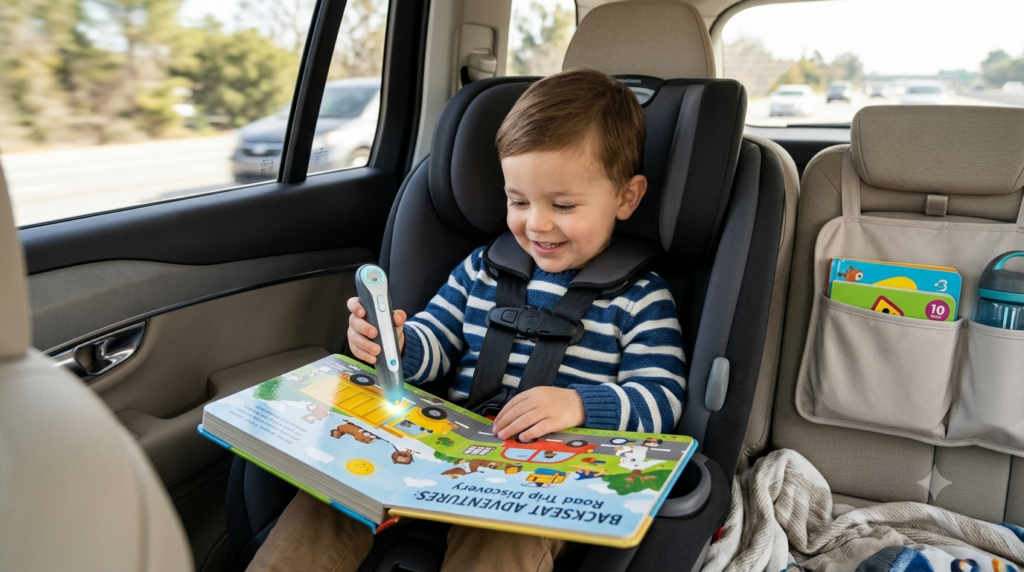
When a toddler clips into their car seat, they can rest a Learning Time A+ storybook on their lap and lift the specialized audio pen. As they tap the printed illustrations, letters, and characters, the physical page immediately responds with clear narrations, rich acoustic effects, fun character dialogue, and matching melodies. The child is fully immersed in a rich, multi-sensory learning experience that keeps their visual, auditory, and tactile senses synchronized.
Because the audio pen delivers precise, immediate acoustic feedback based entirely on the child’s independent touch, the toddler can safely guide their own learning journey for hours. They can dive deep into early mathematics, explore animal tracking, or practice letter sounds at their own pace, while parents focus safely on navigating the road ahead. The Learning Time A+ Program effectively packs an entire early childhood classroom into a single, elegant travel bag, delivering stress-free, clutter-free, and high-impact education wherever your family journeys take you.
Organizing the Vehicle for an Optimized Travel Flow
To guarantee that your screen-free travel strategies execute flawlessly without causing chaotic clutter inside the car, establishing an organized spatial layout and a clear materials rotation is highly beneficial.
Utilizing Backseat Organization Trays
Install a sturdy, multi-pocket organizer that clips securely to the back of the driver or passenger headrest, directly in front of your child’s car seat. This organizer should feature dedicated slots for the Learning Time A+ audio pen, specific books, and sensory boards. When every tool has a clear, accessible home, your toddler can independently retrieve and return their materials without needing a parent to dangerously twist around from the front seat to manage items.
Executing a Strategic Activity Rotation
Do not hand over your entire inventory of travel toys the moment the vehicle leaves the driveway. Instead, reveal only one specific resource or book at a time. Allow your toddler to fully exhaust the educational possibilities of that specific kit before introducing the next option. Keeping a few high-value items hidden away until the midway point of a long drive creates an element of pleasant surprise, instantly renewing their curiosity and focus when travel fatigue begins to set in.
Providing Clear Acoustic Comfort
To allow your child to hear the responsive audio narrations clearly over the background noise of highway driving or airport crowds, pair their learning pen with comfortable, child-safe, volume-limiting headphones. This step ensures that your toddler remains entirely locked into their audio narrative, while creating a peaceful, quiet cabin environment that reduces parental fatigue during long travel hours.
Turning Rest Stops into Collaborative Movement Breaks
Just as structured organization is vital inside the moving car, the scheduled transitions at highway rest stops provide a brilliant opportunity to reinforce early development and physical coordination through collaborative movement.
Gamifying Physical Re-Centering
When pausing for fuel or a meal break, avoid immediately transitioning your toddler to another passive seating arrangement. Instead, spend five to ten minutes engaging in active gross motor games in a safe, grassy area of the rest stop. Play a quick game of follow-the-leader where you both stomp like giants, hop like frogs, or balance carefully along a straight line on the pavement.
Fostering Cooperation and Teamwork
Involve your toddler in the practical steps of the travel routine. Ask them to help carry a light trash bag to a recycling bin, or have them count the steps aloud as you walk together to the rest area entrance. Frame these tasks as a collaborative mission that requires their active assistance. This intentional physical release resets their body boundaries, burns off pent-up energy, and provides a gentle, predictable transition that prepares their mind to re-enter the car seat calmly and contentedly for the next leg of the trip.
The Enduring Benefits of Screen-Free Travel Milestones
The intentional choices made to prioritize screen-free, interactive learning tools during family travel yield incredible developmental rewards that serve your child long after you arrive home. Navigating travel hours with focus and patience establishes a wonderful blueprint for intellectual flexibility and self-regulation.
Children who regularly practice interactive, self-directed play on road trips develop superior task persistence, advanced situational adaptability, and a reduced reliance on constant digital simulation. They learn that transit times are not blank spaces to be erased by a screen, but interesting, active periods of discovery where they can read, think, observe, and master new concepts independently.
By anchoring their travel experience with rich, physical learning platforms like the Learning Time A+ Program, you are protecting their developing visual systems, fostering deep cognitive processing, and teaching them to approach the wider world with genuine curiosity and a calm, focused intelligence.
To discover how you can effortlessly eliminate travel stress and transform your next family road trip into a premier, screen-free educational journey, book a free demo session for the Learning Time A+ Program today. Explore firsthand how our highly portable, responsive audio literature, interactive flashcards, and hands-on learning kits can work together seamlessly to maximize your travel hours, giving your child a rigorous academic head start while preserving total family harmony on the move.