
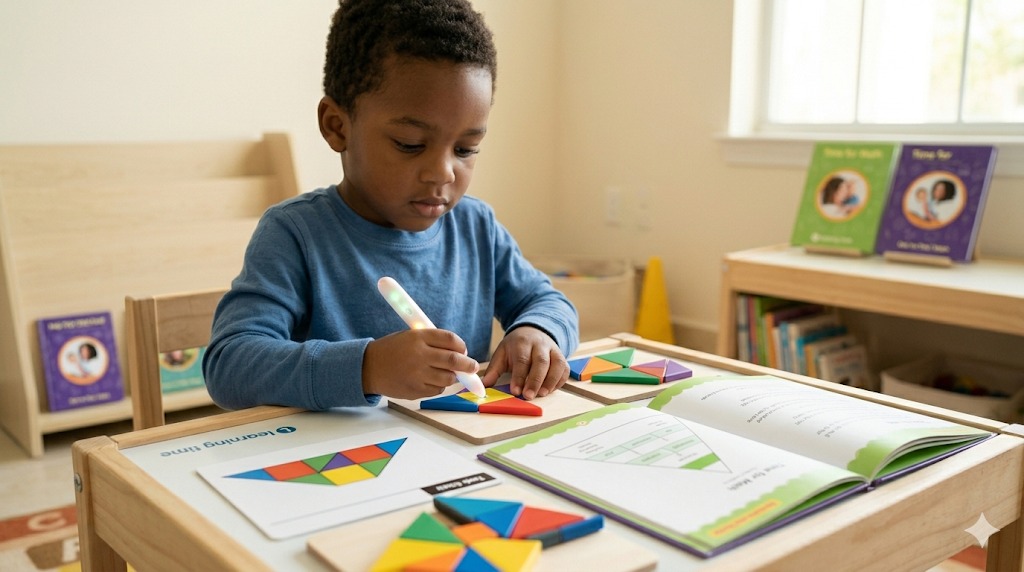
When many parents think of a math whiz, they imagine a child who can quickly add large numbers or recite multiplication tables from memory. However, true mathematical genius is not found in speed or memorization; it is found in logic. At The Little Years with Windress, our goal is to help you move beyond the surface level of education. We want to show you that the secret to raising a child who excels in mathematics is to focus on their ability to reason, analyze, and solve problems. By building a logical foundation during the first six years, you are creating a thinker who can handle any challenge the future brings.
The Difference Between Counting and Logic
It is a common sight to see a toddler proudly counting to ten. While this is a wonderful milestone, it is often a feat of memory rather than a feat of math. Rote counting is similar to reciting a poem; the child knows the order of the words but may not understand the quantity each word represents. To raise a math whiz, we must bridge the gap between the name of the number and the logic of the quantity.
Logic is the understanding of how things relate to one another. It is the ability to see that if you have three apples and you take one away, the relationship between the remaining items has changed. This type of thinking is much more valuable than simply knowing the word “two.” When we focus on logic, we are teaching the child the “why” behind the “what.” This deep understanding is what separates a student who survives math from a student who thrives in it.
Building Analytical Ability through Play
The young brain is perfectly designed to identify patterns and structures. We tap into this natural curiosity by providing activities that require a child to analyze their surroundings. Raising a math whiz starts with simple questions. We ask children to compare objects, categorize shapes, and predict what comes next in a sequence. This is not “school work” in the traditional sense; it is an engaging exploration of the world.
Our parenting consultancy recommends using specialized tools like the Time for Math series to facilitate this exploration. These books don’t just ask a child to count; they ask them to solve mysteries and help characters navigate logical hurdles. When a child has to figure out how many more pieces they need to complete a puzzle, they are practicing high level analytical ability. This is the mental heavy lifting that builds a strong mathematical mind.
The Power of Sequencing and Order
Mathematics is built on the concept of order. Before a child can understand complex arithmetic, they need to understand the logic of sequencing. This means knowing what comes first, middle, and last. It means understanding that there is a specific path from a problem to a solution. This sense of order is a core part of being a math whiz.
We use storytelling and dramatization to make these abstract concepts tangible. Through the Learning Values with Lucy and Wiz series, children follow characters through journeys that have a clear beginning, middle, and end. They see how one action leads to another. This narrative logic is the same logic used in an algebraic equation. By reinforcing these concepts through stories and the interactive Eltee Pen, we are wiring the brain for the structured thinking that mathematics requires.
Developing Spatial Reasoning Skills
A math whiz is often someone who can “see” numbers and shapes in their mind. This is known as spatial reasoning, and it is a critical predictor of future success in science, technology, engineering, and mathematics. Spatial reasoning involves understanding how objects fit together and how they look from different angles.
In our consultancy work, we encourage parents to engage in construction play and puzzle solving. We provide visual tools that challenge children to manipulate shapes and recognize patterns. When a child learns to visualize a three dimensional object from a two dimensional drawing, they are performing a complex mental transformation. These are the “hidden” math skills that provide the foundation for geometry and physics. By focusing on these spatial abilities now, we are ensuring your child has the internal tools to excel later.
Moving from Concrete to Abstract
One of the biggest hurdles in math education is the jump from physical objects to abstract symbols. Many children struggle because this jump is made too quickly. To raise a math whiz, we must ensure the concrete foundation is unshakable. We stay with physical tools—blocks, cards, and tactile books—until the logic of the concept is fully mastered.
The A+ Program is designed to make this transition seamless. We use visual templates that link the physical number of objects to the numeral. By seeing the objects and the symbol together in a logical context, the child’s brain creates a permanent connection. This means that when they eventually see the symbol on its own, their brain instantly recalls the logical quantity it represents. This clarity is what prevents math anxiety and fosters a lifelong love for the subject.
The Role of Vocabulary in Math
It may seem counterintuitive, but language is a vital part of mathematics. A math whiz needs the right vocabulary to describe their logical process. Terms like “altogether,” “difference,” “equal,” and “balance” are the tools of mathematical thought. Without these words, a child may understand a concept but be unable to apply it or explain their reasoning.
Our parenting consultancy emphasizes the importance of a rich linguistic environment. We show you how to use mathematical language during everyday activities. Whether you are talking about the “total” number of steps or the “symmetry” of a butterfly’s wings, you are giving your child the language of logic. This integration of words and numbers is a key feature of our storytelling programs, ensuring that your child is as articulate as they are analytical.
Encouraging a Growth Mindset
A true math whiz is not someone who never makes a mistake; they are someone who is not afraid of the challenge. Mathematical logic often requires trial and error. To build this resilience, we must foster a growth mindset. This means praising the effort and the logical process rather than just the final answer.
We help parents create an environment where “I don’t know” is followed by “yet.” We use our educational problem solving strategies to turn every mistake into a discovery. When a child feels safe to experiment and fail, their brain stays in a state of neuroplasticity. They are more likely to stay engaged with a difficult problem and find a creative solution. This persistence is the most important trait of any successful scientist or mathematician.
Personalized Guidance for Every Parent
Every child’s path to becoming a math whiz is different. Some children are naturally drawn to numbers, while others need a more narrative or tactile approach. As a parenting consultant, I provide the expertise to help you identify your child’s unique strengths. We don’t believe in a one size fits all education. Instead, we offer personalized plans that match your child’s developmental milestones.
Whether you are in Nairobi or operating on a global scale, our team at The Little Years with Windress is dedicated to your success. We provide the strategies and the high quality tools to make math a joyous part of your home life. We are here to answer your questions and provide the support you need to feel confident as your child’s first and most important teacher.
The Long Term Advantage of the A+ Edge
The skills we are building today—logic, analytical ability, and spatial reasoning—are the skills of the future. The A+ Program is not just about getting good grades in school; it is about raising a child who can think for themselves. In a world that is constantly changing, the ability to analyze information and find a logical path forward is the ultimate competitive advantage.
By choosing to focus on logic rather than just counting, you are giving your child a head start that will last a lifetime. They will enter the world with a sense of mastery and a curiosity that cannot be quenched. This is the A+ Edge. It is the confidence that comes from knowing how the world works and having the tools to participate in it fully.
Conclusion: Logic is the Key
Raising a math whiz is about more than just numbers. It is about nurturing a logical, curious, and resilient mind. It is about moving beyond the surface of rote memorization and diving deep into the “why” of mathematics. With the right guidance and the right tools, every child can develop a love for logic.
The Little Years with Windress and the A+ Program are your partners in this mission. Let us help you turn your home into a laboratory of discovery and your child into a confident thinker. The journey to mathematical excellence begins with a single logical step. Join us today and see the incredible potential of your early learner.
Are you ready to raise a confident thinker? Move beyond counting and discover the power of logic. Learn how our parenting consultancy uses the A+ Program to build the analytical skills your child needs for a successful future. Book a Discovery Session with The Little Years with Windress today and start building your child’s A+ Edge.
-
Call/WhatsApp: +254 791 239 414
-
Email: inquiries@thelittleyearswithwindress.com
-
Visit our website: thelittleyearswithwindress.com
-
Discover the Program: learningtime.co