
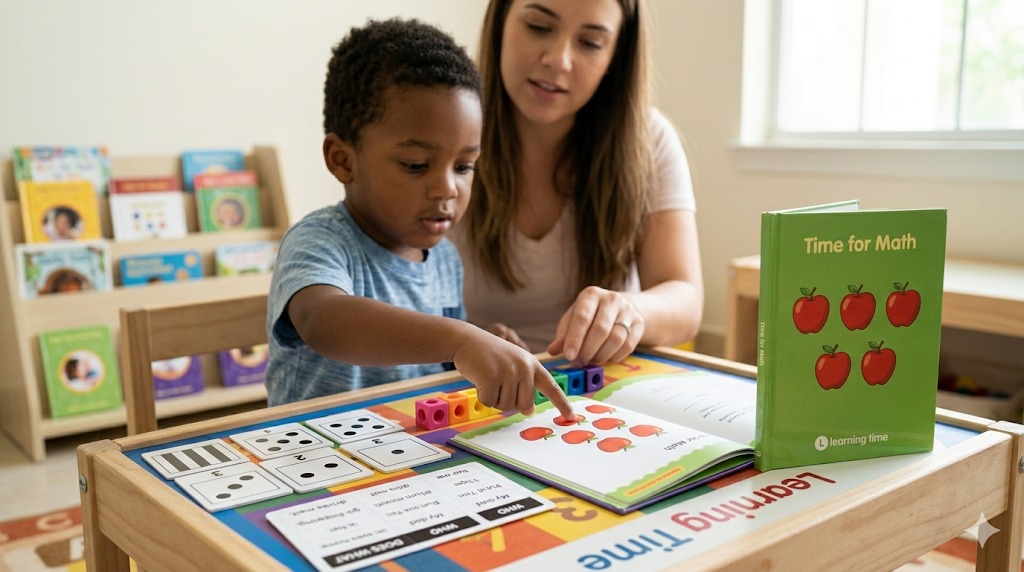
Mathematics is a complex language of patterns and logic. It is natural for young children to take time to master its concepts. However, for some parents, the little years can bring unexpected challenges when their toddler or preschooler shows signs of frustration or confusion with simple counting. At The Little Years with Windress, we understand how concerning it can be when your child struggles with numbers. It is important to know that this is rarely a sign of poor ability; rather, it is usually a mismatch between how your child learns and how the concepts are being presented. We are here to help you identify the root causes of these struggles and provide the right tools to build lasting confidence.
Understanding the Concrete Brain
Young children are concrete learners. This means they process information best when it is presented through their physical senses. They need to touch, see, and move objects to understand what they are. In contrast, mathematical symbols are abstract. The numeral “5” does not have any physical properties of “five-ness” itself. When a child struggles with numbers, it is often because they are being pushed to work with abstract symbols too soon.
Our parenting expertise focuses on making the abstract concrete. We move away from digital apps and simple rote counting. Instead, we use tactile objects, visual aids, and interactive play. When a child can hold five physical blocks, they are engaging their tactical and visual senses. They are not just memorizing a symbol; they are experiencing the quantity of five. This concrete approach builds the strong foundational bridge that the brain needs before it can handle the purely abstract mathematics required in later years.
The Problem of One to One Correspondence
A common milestone that can trip children up is the principle of one to one correspondence. This is the understanding that each object in a group must be counted exactly once, and a specific number name belongs to it. Many young children can recite the counting sequence “one, two, three, four, five” perfectly, but when asked to count five specific items, they might count too fast or too slow, missing objects or counting the same one multiple times.
When a child has this type of difficulty, it often looks as if they don’t know the numbers, but the issue is actually about coordination and cognitive mapping. Our consultancy provides specialized strategies to help strengthen this skill. By slowing down the counting process and encouraging your child to “touch and count” each item, we help them sync their physical action with their logical thought. This small adjustment is incredibly effective at ensuring a child no longer struggles with numbers due to coordination issues.
Identifying Difficulties with Subitizing
Subitizing is a vital mathematical skill that is rarely taught explicitly. It is the ability to recognize a small group of items instantly without needing to count them individually. For instance, when you look at the dots on a dice, you instantly know if you see “4” or “5.” You don’t have to count “one, two, three, four.” For some children, this skill does not develop naturally.
If a child consistently needs to count even the smallest quantities, they may be suffering from weak subitizing skills. This can make simple arithmetic feel incredibly slow and frustrating, as the child spends all their cognitive energy on the basic task of establishing the initial quantity. We use flashcards, visual patterns, and memory games from our program toolkit to help train this skill. Strong subitizing is a secret mathematical superpower. It speeds up the learning process and gives the child the mental room to handle more complex equations.
Overcoming Reversal and Inversion Hurdles
When children first start writing numbers, it is extremely common for them to reverse numbers. A “3” might look like an “E,” or a “7” might face the wrong way. For many children, this is just a stage of physical and visual-spatial development. However, if these reversals persist or if the child seems truly confused by which numeral is which, it is a sign that they are not connecting the symbol to its actual meaning.
If your child struggles with numbers in this way, it is a cue to move back to a concrete method of representation. We recommend using a multi-sensory approach. This means modeling numbers using playdough, tracing them in the sand, or building them with blocks. By using their whole body to experience the shape of the symbol, they are cementing the connection between the numeral and its value. This physical anchoring makes reversals much less likely to cause anxiety or deep confusion.
Recognizing the Emotional Block
Mathematics is uniquely prone to inducing emotional blocks. A negative experience or an early feeling of being “not good at math” can quickly turn into anxiety. This emotional weight actually blocks the brain’s ability to process mathematical logic. When a child feels stressed, they shift into their primal brain, which handles “fight or flight,” leaving the frontal cortex which handles logic and analysis temporarily offline.
Our approach to parenting emphasizes the emotional state of the learner. Solving mathematical anxiety is our specialty. We provide a supportive, low pressure home environment where mistakes are celebrated as learning opportunities. We focus on joyful discovery through storytelling and active play. When math is part of a fun mission, like helping a character like Wiz count their treasures, the brain stays relaxed and receptive. We believe that raising a confident thinker means first protecting their emotional confidence.
The Power of Visual Representations
Once we have identified the cause of a struggle, we deploy our primary tool: visualization. Visual tools are the ultimate solution for children who struggle with numbers. Because the brain is largely visual, providing clear, attractive, and concrete images helps the abstract concepts of math finally make sense.
We encourage the use of ten-frames, number lines, and illustrated storybooks. In our A+ Program, we use visual metaphors to explain foundational logic. We might show a subtraction problem as a tree losing its leaves. This visual narrative tells the child the “why” behind the mathematical symbol. It allows them to use their creative and visual brain to solve the logic, rather than relying solely on memory. When a child can visualize a math problem, it stops being a struggle and starts being a picture they can understand.
Why Multi Sensory Tools Outperform Abstract Drills
The biggest mistake we can make when a child struggles with numbers is to give them more abstract drills. Repeating the same abstract problem won’t help if they don’t understand the underlying concept. Instead, we must change the delivery method. This is where multi-sensory tools become essential.
Our programs incorporate auditory feedback, tactile manipulation, and vibrant visuals simultaneously. When a child uses our specialized tools to interact with a page, they might hear the numeral pronounced, see a visualization of its value, and physically point to the item. This triples the cognitive input, making it much more likely that the concept will be locked in. By building a rich sensory network around numbers, we ensure that the child is not just memorizing symbols, but truly grasping their meaning.
Personalized Consultancy for Your Child’s Journey
Being a parent is a rewarding, yet demanding journey. We know that as a parent you want the best for your child’s cognitive development, especially when faced with specific educational hurdles. The team at The Little Years with Windress is here to provide you with the expertise needed to support your child’s unique learning style. We offer personalized coaching to help you implement effective educational problem solving.
From tracking cognitive milestones to customized learning plans, our parenting consultancy ensures you have the right tools to turn a moment of struggle into a major accomplishment. Whether you are in Kenya or anywhere else in the world, we are dedicated to helping you raise a child who stands out. We provide the strategies so you can focus on the joy of watching your child discover and thrive.
Building Success for Primary School
The primary school classroom can be an intimidating environment for a child who is already hesitant about math. Solving these mathematical issues during the little years is crucial. We want your child to enter the classroom already viewing themselves as capable, creative, and confident thinkers.
By identifying the areas where your child struggles with numbers and addressing them with positive, effective methods now, you are ensuring they have a head start. They will have the cognitive flexibility and analytical ability to keep up with and excel at the modern, competency-based curriculum. They will enter school not as a child who fears math, but as one who sees it as an engaging puzzle to be solved. This confidence is the greatest competitive advantage you can give them.
Final Thoughts: Every Struggle is an Opportunity
Every challenge is just a sign that your child needs a new perspective. If your child struggles with numbers, it does not define their potential. In fact, we often find that the children who struggle are the most creative thinkers, they just need a different pathway to access mathematical logic.
At The Little Years with Windress, we are dedicated to providing that pathway. With our supportive parenting expertise and the innovative, multi-sensory tools of the A+ Program, we can build a strong foundation of mathematical excellence together. Let us help you turn a source of stress into a moment of victory. The future of your child’s cognitive potential is limitless, and we are ready to help them unlock it. Your next step toward raising a smart thinker is just a discovery session away.
Are you ready to turn mathematical confusion into clarity? Don’t let early hesitation about numbers limit your child’s future. Discover how our parenting consultancy uses visual tools and expert guidance to help your child overcome mathematical hurdles and build lasting confidence. Book a Discovery Session with The Little Years with Windress today and give your child the A+ Edge.
-
Call/WhatsApp: +254 791 239 414
-
Email: inquiries@thelittleyearswithwindress.com
-
Visit our website: thelittleyearswithwindress.com
-
Discover the Program: learningtime.co